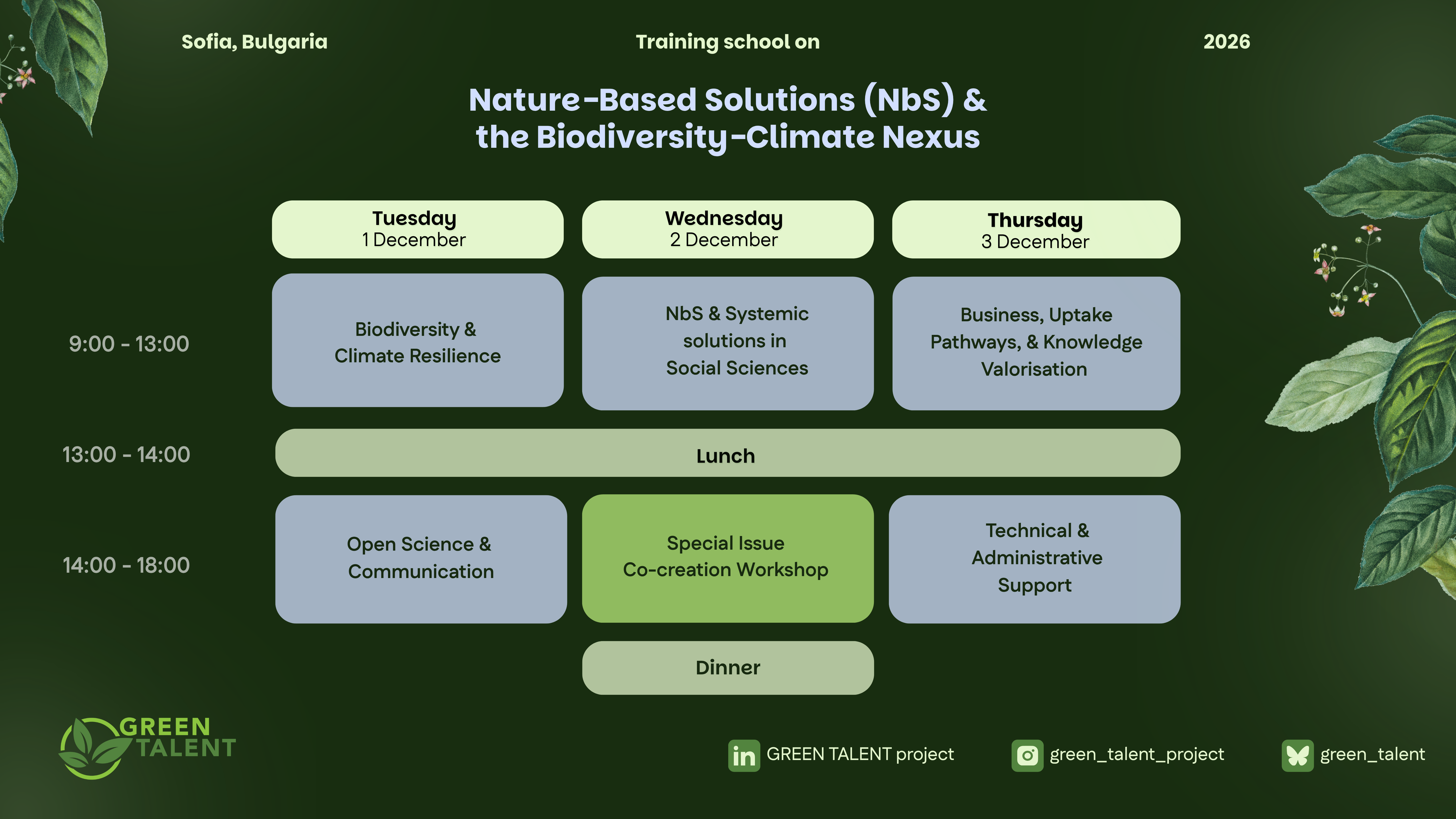
The GREEN TALENT training school aims to foster a better understanding of the role of nature-based solutions (NbS) in addressing biodiversity loss and climate change together. Experts will provide intensive training on designing and applying approaches to assess the co-benefits, trade-offs, and implementation challenges of NbS for biodiversity conservation, climate mitigation, and adaptation, while also considering ecosystem resilience and human well-being.

Outcomes of the training
Upon completion of the training school, it is intended that you will be able to:
- Critically appraise and design systemic NbS approaches to interconnected environmental and societal challenges across the biodiversity–climate nexus.
- Translate research into impact by developing credible pathways for the uptake of NbS across policy, business and society.
- Apply the principles of project management to support grant coordination, workflows, reporting, open data, digital collaboration and research compliance.
- Communicate research more effectively to scientific, policy, and public audiences.
As part of the Training School, you will also develop new networks and relationships with other ECRs through practical case studies, pathway mapping, and solution-development exercises.

Additionally, you will be invited to contribute a paper to a special issue on the Biodiversity–Climate–Society Nexus. As part of the training school, on December 2nd our partners from the University of Helsinki will host a workshop to co-develop a topical collection call titled “The biodiversity-climate-health nexus: Concepts, methodologies, and pathways for research and action."
The collection responds to growing recognition of the interdependencies and feedbacks between climate change, biodiversity loss, and health impacts. While established methods exist for assessing each in isolation, far less is known about the biophysical and socio-economic implications of their interactions or the combined effects of programs, such as nature-based solutions, that address one or more of them.
The workshop will bring together early-career and senior researchers to shape a call for high-quality reviews, perspectives, methodological and empirical studies, and case studies. Topics may include knowledge gaps and tensions in nexus assessments, policy and planning implications for sustainability transformation, co-benefits and trade-offs of nexus interactions in urban, regional, and rural land management, and the governance and learning challenges of putting the nexus into practice. 
Here you can find an overall programme for the event.